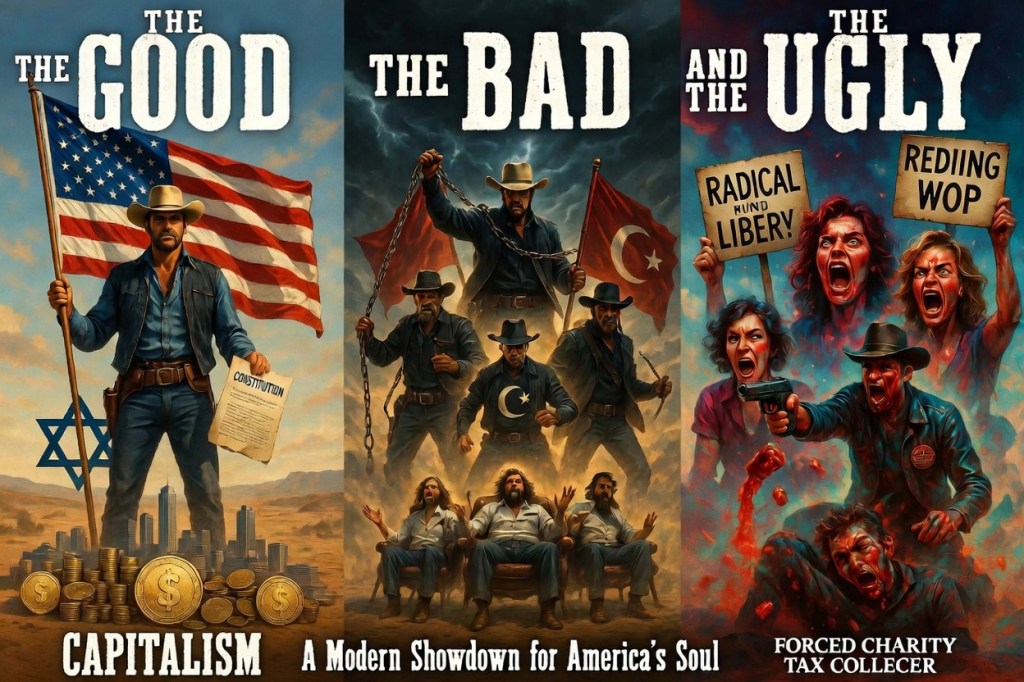
I love Western movies, and one of my favorites is The Good, the Bad, and the Ugly. In the spirit of this great movie, here is a script for a modern take on The Good, the Bad, and the Ugly.
In the sun-baked frontier of ideas, where freedom’s dust swirls and tyranny casts long shadows, three forces clash like gunslingers at high noon. This ain’t no Hollywood fairy tale. This is the real American West—raw, unforgiving, and worth dying for.
The Good They ride tall in the saddle: Individualism, the lone rider who answers only to his own conscience and his Maker. Beside him gallops Capitalism, the engine of creation that turns sweat into wealth and dreams into steel skyscrapers. They carry the Constitution like a sacred Colt—loaded with rights, not permissions. Their banner is the USA, that shining land, forged in rebellion against kings and collectives alike. Zionism stands with them, the ancient grit of a people who refused to kneel, as they rebuild their homeland against all odds. Masculinity—unapologetic, protective, decisive—provides the muscle and the moral spine. Accountability keeps every man’s ledger straight: you reap what you sow. And Sustainability? Not the green cult’s version, but the real kind—generations of innovators who steward the land, build lasting wealth, and leave more than they take. These are the heroes. They don’t ask permission to thrive.
The Bad Then come the varmints, the ones who poison the water hole. Collectivism herds people into faceless mobs, trading liberty for chains. Socialism and Communism ride shotgun, promising paradise while delivering bread lines, gulags, and secret police. They’ve failed wherever they’ve drawn iron, yet they keep slithering back like rattlesnakes. Islamism brings the worst of the badlands—a supremacist ideology wrapped in prayer rugs, demanding submission while carving enclaves and waging demographic and cultural conquest. Entitlement whispers sweet lies: “You deserve it without earning it.” And Income Tax? The government’s favorite cattle brand forever marked free men as livestock. These forces don’t build. They loot, control, and leave scorched earth.
The Ugly And then there’s the grotesque. Feminism, twisted from any noble root into a war on men, family, and biological reality—turning daughters into resentful foot soldiers and sons into soft targets. Woke Liberal Women, the shrill chorus in the saloon, preach tolerance while enforcing new puritanisms: cancel culture, speech codes, and guilt rituals. They champion every “oppressed” ideology except those that would actually put them in burqas. Forced charity tops the ugly heap—the state’s gun-to-the-head redistribution that turns voluntary goodwill into mandatory plunder. It doesn’t lift the poor; it breeds dependency and resentment, while the enforcers live fat in their gated compounds.
In this dusty showdown, the choice is clear. The Good built America. The Bad and the Ugly are tearing it down, one regulation, one concession, and one guilt trip at a time.
Time to choose your side, partner. Draw fast, aim true, and never apologize for standing with what’s right. The frontier remains open—for those with the courage to defend it.
Might Is Right: The Brutal Truth in Politics, War, and Real Life
In the arena of human affairs, few principles cut through the illusions of morality, law, and “fairness” like “Might is Right.” This ancient idea—that power, strength, and the will to wield them ultimately decide what prevails—underpins reality more than most care to admit. It echoes through history, from Thucydides’ Melian Dialogue (“the strong do what they can and the weak suffer what they must”) to modern geopolitics and everyday struggles. Deny it at your peril. Civilizations built on wishful thinking crumble when raw power confronts them.
Might in Politics: The Illusion of Consent
Politics is not a gentle debate club of ideas. It is the organized exercise of power. “Might is Right” reveals that elections, constitutions, and parliaments often serve as velvet gloves over iron fists. The side with superior organization, financial muscle, demographic leverage, cultural dominance, or willingness to intimidate wins. History’s tyrants understood this instinctively.
Communist regimes exemplified it brutally: Lenin’s Bolsheviks seized Russia not by the will of the majority but by disciplined force and terror. Mao’s China consolidated power by the barrel of the gun. Today’s softer variants persist—ideological capture of institutions, censorship disguised as “hate speech” laws, demographic engineering through mass migration, and economic coercion. In the West, elites wield regulatory power, media monopolies, and financial leverage to marginalize dissent. Islamism follows the same pattern: where it gains numbers and institutional footholds (New York City, Dearborn, Hamtramck, parts of Europe), it demands accommodations, then dominance. Adhan blasts that overwhelming neighborhoods aren’t requests; they are assertions of territorial might through noise and presence.
Individualists reject the collectivist lie that “the people,” “the ummah,” or “the proletariat” hold legitimate power. Legitimacy flows from protecting individual rights, not from mob or clerical force. Yet reality bites: a determined minority wielding might—street muscle, bureaucratic control, or voting blocs—can impose its will on a disorganized majority. The American Founders grasped this by embedding checks and balances and an armed citizenry to counterbalance raw might with structured liberty. Without vigilance, might devours rights. Civilized intolerance toward supremacist ideologies isn’t hatred—it’s the necessary assertion of Western might to preserve freedom.
Might in War: The Decider of Civilizations
War strips away pretenses. Treaties, norms, and Geneva Conventions bind only the weak or those who fear reprisal. Victors write history and define “justice.”
The Islamic conquests spread by the sword from Arabia across continents, subjugating cultures under Sharia. The Ottoman Empire’s might enforced dhimmitude. In the 20th century, Nazi Germany’s blitzkrieg and imperial Japan’s aggression showed might’s logic until greater industrial and military might crushed them. Today’s conflicts—Ukraine, Middle East proxy wars, Islamist insurgencies—follow suit. Hamas, Hezbollah, and their backers prioritize rockets, tunnels, and human shields over “proportionality.” They understand that survival favors the ruthless.
Even “rules-based” powers bend to might. Nuclear deterrence works because mutual assured destruction enforces a balance of terror. Weak nations invite predation; strong ones project power. America’s post-WWII order succeeded through overwhelming might paired with relative restraint—not universal benevolence. In the “Adhan Noise Wars” and cultural infiltration, the pattern repeats domestically: incremental assertions of power (loudspeakers, parallel societies, demands for blasphemy laws) test resolve. Yield, and enclaves become caliphates. Resist with superior cultural, legal, economic, and, if needed, physical might—or lose.
Might does not make moral right, but it determines who survives to argue the point. Pacifism in the face of jihad or totalitarianism is suicide.
Might in Real Life: Daily Power Struggles
“Might is Right” applies on the personal scale, too. In business, the stronger negotiator, the better-capitalized firm, or the more persistent competitor prevails.
Socially, status, networks, physical presence, and psychological resilience determine outcomes. Bullies test boundaries; the unprepared suffer. In relationships and communities, those willing to enforce standards—through reputation, alliances, or direct confrontation—shape norms. Demographic shifts in neighborhoods demonstrate this: groups with higher birthrates, chain migration, and communal solidarity impose their culture when the host society lacks the will to assert its own.
Yet might without wisdom destroys. A thug with fists rules the street until law enforcement (greater might) intervenes. A corrupt politician dominates until exposed and replaced. Raw power, unchecked, breeds chaos; channeled through principle, it builds enduring order.
The Individualist Response: Structured Might
“Might is Right” is descriptive, not prescriptive. It reveals human nature stripped of delusion. Collectivists—Islamists and Communists—embrace it openly in pursuit of domination. Individualists must wield it defensively to preserve themselves and promote human flourishing.
The antidote isn’t pretending at equality of outcome or universal goodwill. It is cultivating personal strength (mind, body, resources), defending the rule of law that protects the sovereign individual, and asserting cultural might through truth-telling, economic boycotts, legal pushback, and demographic realism. The “Infidel Manifesto” spirit—civilized intolerance toward political Islam and collectivism—embodies this: recognize the threat, reject naive coexistence, and mobilize superior ideas backed by resolve.
Live and let live, but do not surrender to those who proclaim “convert, submit, or die.” Arm yourself with knowledge of history, the Quran, the Sira, and the Hadith. Build parallel structures that resist infiltration. Support leaders and policies that prioritize national sovereignty and individual rights over globalist or theocratic power.
In the end, might decides. The question is whether free individuals and their civilizations will summon the strength to prevail—or whimper into subjugation. History favors the bold who understand power. The rest become footnotes.
The time for illusions is over. Assert what is right—by force, if necessary.
The Islamic “Street Prayer” A War Tactic: Blocking American Roads to Intimidate Non-Muslims and Carve Out Islamic Enclaves By FightIslamization.com Published: March 27, 2026
Across America, a deliberate and increasing tactic of Islamization is taking shape in plain sight: large groups of Muslims blocking public streets, intersections, and iconic areas under the guise of “prayer.”
What appears to be peaceful religious observance is, in reality, a calculated assertion of dominance. By blocking roads, stopping traffic, and making non-Muslims go around or wait during Islamic rituals, these actions scare local communities, disrupt everyday life, and indicate the creation of Islamic-controlled areas where Sharia laws take precedence over American civic order.
This is not spontaneous worship due to a lack of mosques—many incidents occur in cities with dozens or hundreds of mosques nearby. Instead, it mirrors tactics used in Europe and the Middle East to claim territory, normalize Islamic supremacy, and pressure authorities into concessions. In the United States, this “street prayer” strategy has accelerated over the last decade, especially in Muslim-concentrated areas like New York City, Philadelphia, and beyond. It creates de facto no-go zones where non-Muslims feel unwelcome, and authorities hesitate to intervene.
Below is a documented list of key incidents from the last 10 years (2016–2026). Each includes date, location, description, and links to photos/videos for verification. These are not isolated events but part of a pattern.
Documented Street-Blocking Prayer Incidents in America (2016–2026)
1. September 15, 2023 – Ongoing (Weekly Fridays): Brooklyn, New York – Chester Avenue (Masjid Nur Al-Islam, Kensington) The New York City Department of Transportation granted Masjid Nur Al-Islam an official “open streets” permit, closing Chester Avenue to traffic every Friday from noon to 3 p.m. for Jummah (Friday) prayers. Worshippers lay out hundreds of prayer mats directly on the roadway, blocking the street while non-Muslim drivers and residents are rerouted. Councilmember Shahana Hanif (Bangladeshi American) championed the permit, calling it a “community builder.” In reality, it hands public space to Islamic observance year-round.
Significance: This set a precedent for legal street takeovers, turning a public road into an extension of the mosque.
2. July 2025 (and recurring Fridays): Philadelphia, Pennsylvania – Multiple City Streets Despite over 82 mosques in Philadelphia, large groups of Muslim men blocked entire streets during prayer times, laying mats on roadways and halting traffic. Viral videos captured cars stopped as worshippers performed Zuhr or other prayers in the middle of busy roads. NBA legend Ron Harper reacted strongly, suggesting drivers “run them over” in frustration at the disruption.
Video/Photo Evidence:
Viral footage of street shutdown (widely shared July 24–25, 2025): Search “Philadelphia Muslims block street prayer 2025” on X or Facebook (e.g., posts by Terrence K. Williams and America Now).
Photo still from the incident showing worshippers on the roadway with waiting vehicles: available via India Herald coverage and Reddit discussions.
Significance: Demonstrates the tactic even in cities with abundant mosques, prioritizing public dominance over civic convenience.
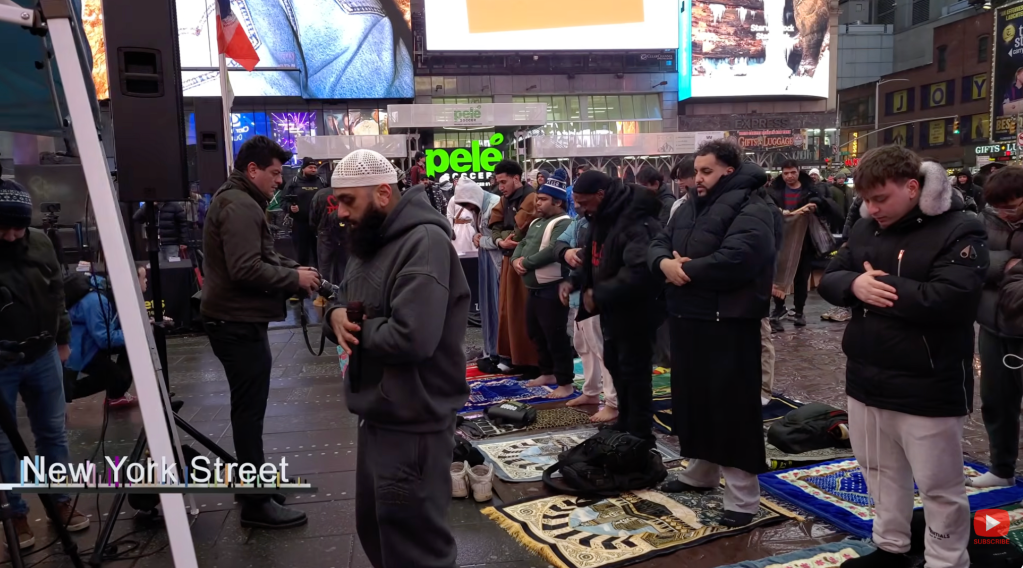
3. February 20, 2026 (Annual since 2022 – 5th Year): Times Square, New York City – Broadway and Seventh Avenue Thousands of Muslims gathered for Taraweeh prayers during Ramadan, completely overtaking the iconic Times Square area. Prayer mats filled the streets and sidewalks as worshippers chanted and prayed, blocking pedestrian and vehicle flow in one of America’s busiest tourist hubs. Organizers provided free iftar meals, turning it into a major public display. Previous years (2022–2025) saw similar takeovers during Ramadan.
High-resolution image of worshippers filling the street under billboards: Search “Muslims pray Times Square Ramadan 2026”.
Significance: Symbolizes the “takeover” of America’s cultural heartland, with chants of “Allahu Akbar” echoing as non-Muslims are sidelined.
4. November 21, 2025: Brooklyn, New York – Neptune Avenue (Masjid Omar / Islamic Center of Brighton Beach) A large group performed afternoon prayers directly on the street, with rows of men prostrating while cars waited. The video went viral amid claims of early-morning Fajr prayers (later clarified as daytime), highlighting repeated street usage despite nearby mosques.
Additional footage circulated on social media showing blocked traffic.
Significance: Part of NYC’s broader pattern of normalizing street prayer as a show of numbers and control.
5. Additional Pattern Incidents (2016–2024)
Chicago, Illinois (Multiple 2020s incidents): Footage of hundreds gathering for street prayers, blocking roads during large events (viral clips from 2024–2025).
Dearborn/Hamtramck, Michigan (Ongoing since ~2016): While focused more on amplified calls to prayer and protests, street prayers during rallies and holidays have contributed to enclave formation in these Muslim-majority areas.
Minneapolis, Minnesota (Somali enclaves, 2018–2025): Reports of street prayers spilling into roads amid high Muslim immigration.
These incidents are supported by viral videos, local news reports, and eyewitness accounts. Many occur during Jummah or Ramadan, when crowds are largest.
Why This Is a War Tactic, Not Religious Freedom
Intimidation: Non-Muslims face delays, honking, and pressure to yield—creating fear and resentment.
Enclave Creation: Repeated occupations mark territory, discouraging outsiders and encouraging further Muslim settlement.
Legal Concessions: Cities like NYC grant permits, eroding equal application of traffic laws (compare to denied Christian or other events).
Precedent from Abroad: Europe’s experience shows that street prayers evolve into demands for Sharia zones, no-go areas, and parallel societies.
America must wake up. This is not “diversity”—it is incremental Islamization through disruption and dominance. Local governments must enforce traffic laws equally, revoke special permits, and reject street closures for religious rituals. Citizens should document and report every incident.
Share this article. Demand action from your city council. Fight Islamization before American streets become permanent Islamic prayer zones.
Sources: Gothamist, Brooklyn Paper, Reuters, YouTube footage, viral social media reports (2023–2026). All incidents are publicly documented.
The United States is often described simply as “a democracy.” That description is incomplete.
From its founding, the United States was established as a constitutional republic—designed to limit majority rule through law, structure, and institutional constraints. This framework is laid out in the United States Constitution.
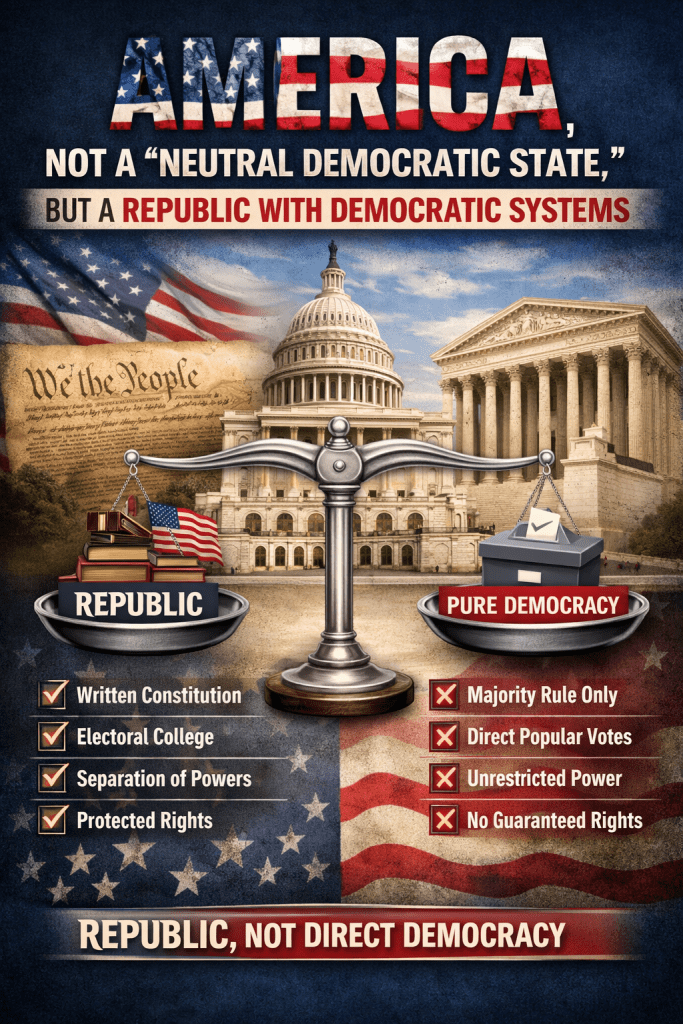
America was not created as a system of pure, direct democracy. It was designed as a republic that incorporates democratic mechanisms within a system of checks and balances and protections against majority excess.
A REPUBLIC WITH DEMOCRATIC MECHANISMS
The United States uses democratic processes: elections, representation, and political competition. However, these operate within a constitutional framework that constrains power.
This creates a dual structure: Foundational system: a constitutional republic Operational tools: democratic elections and representation
Key features reinforce this structure: Elected representatives—not direct rule by the public The Electoral College for presidential elections A bicameral legislature balancing population and state representation Judicial review limiting legislative and executive power
This is not a pure democracy. It is a republic that uses democratic systems.
CONSTITUTIONAL LIMITS ON MAJORITY RULE
In a pure democracy, the majority can impose its will directly. In the United States, that power is deliberately restricted.
The Constitution establishes: Separation of powers between branches of government Federalism, dividing authority between national and state governments Entrenched rights that cannot be overridden by a simple majority vote
The United States Bill of Rights explicitly protects individual freedoms from government action—even if a majority supports restrictions. This is a defining characteristic of a republic: rights are not subject to popular vote.
NO IDEOLOGICAL NEUTRALITY IN FOUNDING PRINCIPLES
The United States is often described as “neutral,” but its founding is rooted in specific philosophical principles. These include: Individual rights Limited government Rule of law Protection of private property
These principles are embedded in the United States Declaration of Independence and reflected throughout the constitutional system. The state is not ideologically empty—it is built on a defined political philosophy.
AMERICA VS. PURE DEMOCRACY: A STRUCTURAL DIFFERENCE
Understanding the United States requires distinguishing it from a pure democracy.
SOURCE OF AUTHORITY United States: Authority is constrained by a written constitution. Pure democracy: Authority flows directly from majority rule.
DECISION-MAKING United States: Indirect, through elected representatives and layered institutions. Pure democracy: Direct voting on laws and policies.
LIMITS ON POWER United States: Constitutional rights override majority decisions. Pure democracy: Majority decisions are typically final.
STRUCTURE United States: Federal system with divided sovereignty. Pure democracy: Centralized authority based on voter outcomes. A DISTINCT MODEL — NOT PURE DEMOCRACY
The United States does not fit the definition of a pure democracy: It is not direct rule by the majority It is not a system without constitutional constraints
It is a constitutional republic that uses democratic processes within defined limits.
WHY THE DISTINCTION MATTERS
Calling the United States simply “a democracy” obscures how the system actually functions.
The American system was designed to: Prevent concentration of power Protect individual rights against majority pressure Ensure long-term stability over short-term popular demands Understanding this structure is essential to understanding American governance.
CONCLUSION
The United States is best understood as: A constitutional republic Operating through democratic elections Structured to limit and balance power
It is not a neutral, unconstrained democracy. It is a republic with democratic systems—by design.