Fix America First: Reclaiming Our Cities from Islamist Conquest
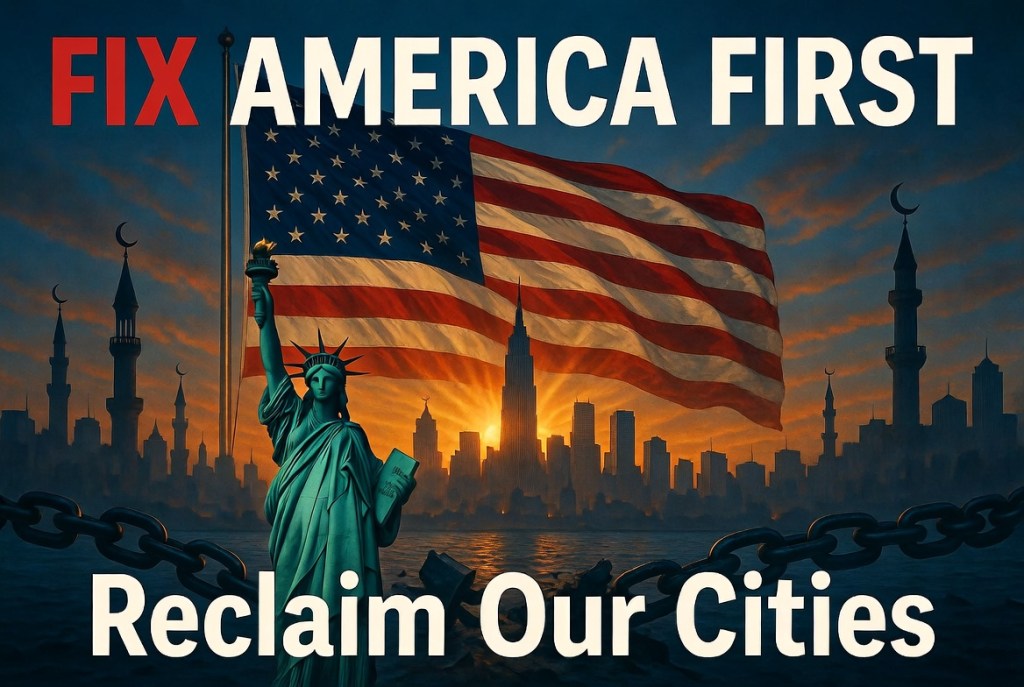
America’s greatest threat isn’t thousands of miles away; it’s right here in our own cities. While we are confronting Islamist regimes abroad, radical Islamists fused with socialist enablers are seizing control at home. New York City, once the proud symbol of American strength, has surrendered to Zohran Mamdani, an Islamist Communist anti-American mayor who took office in January 2026.
Mamdani, a Democratic Socialist with a record of pro-Palestine activism, represents the toxic merger of supremacist ideology and Marxist grievance. Under his leadership, expect amplified Adhan calls to prayer dominating neighborhoods as territorial markers, demands for Sharia accommodations, eroded law and order, and policies that favor imported collectives over American taxpayers and traditions. New York, still bearing the scars of 9/11, now stands as a warning of demographic conquest through the ballot box—fueled by open borders, zero assimilation, and elite betrayal.
This isn’t limited to NYC. Dearborn, Hamtramck, Minneapolis, and expanding enclaves across America are falling into the same pattern: parallel societies rejecting Western freedoms on women’s rights, free speech, secular governance, and individual liberty. Noise wars, no-go pressures, and cultural dominance grow bolder by the day.
Prioritize home. Fix America first. Before any foreign adventures or global lectures, secure our sovereignty. Reject Sharia courts and all parallel legal systems. Demand full assimilation or removal. Seal the borders against unvetted migration. Protect American neighborhoods, culture, and values above all.
This is civilized intolerance: unapologetic self-defense rooted in reciprocity. Live and let live applies only to those who accept it. The Individual Comes First—not theocracies, not socialist hordes, not foreign ideologies.
Reclaim our streets, our cities, our Republic. The stars and stripes must fly unchallenged over sovereign American soil. Hypocrisy at home guarantees decline. Clarity, resolve, and domestic priority deliver renewal. Start here, New York, Dearborn, and every threatened community, or lose the nation we pretend to defend.
Might Is Right: The Brutal Truth in Politics, War, and Real Life
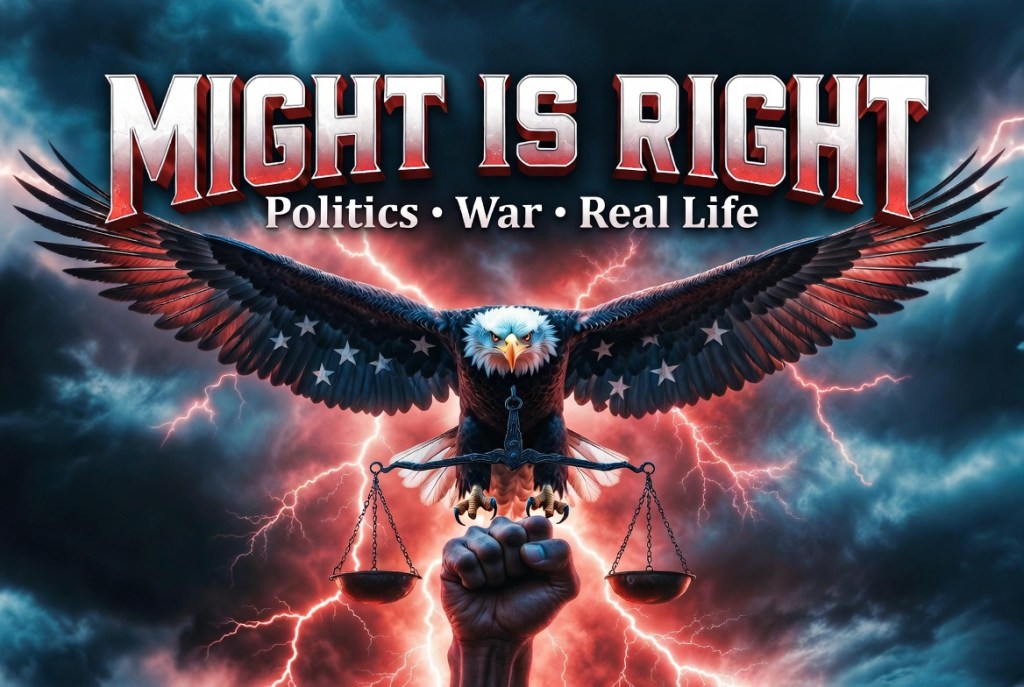
In the arena of human affairs, few principles cut through the illusions of morality, law, and “fairness” like “Might is Right.” This ancient idea—that power, strength, and the will to wield them ultimately decide what prevails—underpins reality more than most care to admit. It echoes through history, from Thucydides’ Melian Dialogue (“the strong do what they can and the weak suffer what they must”) to modern geopolitics and everyday struggles. Deny it at your peril. Civilizations built on wishful thinking crumble when raw power confronts them.
Might in Politics: The Illusion of Consent
Politics is not a gentle debate club of ideas. It is the organized exercise of power. “Might is Right” reveals that elections, constitutions, and parliaments often serve as velvet gloves over iron fists. The side with superior organization, financial muscle, demographic leverage, cultural dominance, or willingness to intimidate wins. History’s tyrants understood this instinctively.
Communist regimes exemplified it brutally: Lenin’s Bolsheviks seized Russia not by the will of the majority but by disciplined force and terror. Mao’s China consolidated power by the barrel of the gun. Today’s softer variants persist—ideological capture of institutions, censorship disguised as “hate speech” laws, demographic engineering through mass migration, and economic coercion. In the West, elites wield regulatory power, media monopolies, and financial leverage to marginalize dissent. Islamism follows the same pattern: where it gains numbers and institutional footholds (New York City, Dearborn, Hamtramck, parts of Europe), it demands accommodations, then dominance. Adhan blasts that overwhelming neighborhoods aren’t requests; they are assertions of territorial might through noise and presence.
Individualists reject the collectivist lie that “the people,” “the ummah,” or “the proletariat” hold legitimate power. Legitimacy flows from protecting individual rights, not from mob or clerical force. Yet reality bites: a determined minority wielding might—street muscle, bureaucratic control, or voting blocs—can impose its will on a disorganized majority. The American Founders grasped this by embedding checks and balances and an armed citizenry to counterbalance raw might with structured liberty. Without vigilance, might devours rights. Civilized intolerance toward supremacist ideologies isn’t hatred—it’s the necessary assertion of Western might to preserve freedom.
Might in War: The Decider of Civilizations
War strips away pretenses. Treaties, norms, and Geneva Conventions bind only the weak or those who fear reprisal. Victors write history and define “justice.”
The Islamic conquests spread by the sword from Arabia across continents, subjugating cultures under Sharia. The Ottoman Empire’s might enforced dhimmitude. In the 20th century, Nazi Germany’s blitzkrieg and imperial Japan’s aggression showed might’s logic until greater industrial and military might crushed them. Today’s conflicts—Ukraine, Middle East proxy wars, Islamist insurgencies—follow suit. Hamas, Hezbollah, and their backers prioritize rockets, tunnels, and human shields over “proportionality.” They understand that survival favors the ruthless.
Even “rules-based” powers bend to might. Nuclear deterrence works because mutual assured destruction enforces a balance of terror. Weak nations invite predation; strong ones project power. America’s post-WWII order succeeded through overwhelming might paired with relative restraint—not universal benevolence. In the “Adhan Noise Wars” and cultural infiltration, the pattern repeats domestically: incremental assertions of power (loudspeakers, parallel societies, demands for blasphemy laws) test resolve. Yield, and enclaves become caliphates. Resist with superior cultural, legal, economic, and, if needed, physical might—or lose.
Might does not make moral right, but it determines who survives to argue the point. Pacifism in the face of jihad or totalitarianism is suicide.
Might in Real Life: Daily Power Struggles
“Might is Right” applies on the personal scale, too. In business, the stronger negotiator, the better-capitalized firm, or the more persistent competitor prevails.
Socially, status, networks, physical presence, and psychological resilience determine outcomes. Bullies test boundaries; the unprepared suffer. In relationships and communities, those willing to enforce standards—through reputation, alliances, or direct confrontation—shape norms. Demographic shifts in neighborhoods demonstrate this: groups with higher birthrates, chain migration, and communal solidarity impose their culture when the host society lacks the will to assert its own.
Yet might without wisdom destroys. A thug with fists rules the street until law enforcement (greater might) intervenes. A corrupt politician dominates until exposed and replaced. Raw power, unchecked, breeds chaos; channeled through principle, it builds enduring order.
The Individualist Response: Structured Might
“Might is Right” is descriptive, not prescriptive. It reveals human nature stripped of delusion. Collectivists—Islamists and Communists—embrace it openly in pursuit of domination. Individualists must wield it defensively to preserve themselves and promote human flourishing.
The antidote isn’t pretending at equality of outcome or universal goodwill. It is cultivating personal strength (mind, body, resources), defending the rule of law that protects the sovereign individual, and asserting cultural might through truth-telling, economic boycotts, legal pushback, and demographic realism. The “Infidel Manifesto” spirit—civilized intolerance toward political Islam and collectivism—embodies this: recognize the threat, reject naive coexistence, and mobilize superior ideas backed by resolve.
Live and let live, but do not surrender to those who proclaim “convert, submit, or die.” Arm yourself with knowledge of history, the Quran, the Sira, and the Hadith. Build parallel structures that resist infiltration. Support leaders and policies that prioritize national sovereignty and individual rights over globalist or theocratic power.
In the end, might decides. The question is whether free individuals and their civilizations will summon the strength to prevail—or whimper into subjugation. History favors the bold who understand power. The rest become footnotes.
The time for illusions is over. Assert what is right—by force, if necessary.
Socio-Feudalism’s War on the Individual By Daniel Greenfield
The transformation of the medieval world into the modern world came about with the idea that man could and should transform his lot in life.
The liberal individualism of the Enlightenment however was soon countered by reactionary movements, feudal and socio-feudal, seeking to put the genie of individual autonomy back in the box through collectivist movements.
Socialism postured as progressive when it was reactionary. Its leaders, most often hailing from the upper class and upper middle class, reverted newly liberated societies in Russia and China back to feudalism under the guise of liberating them. The Bolsheviks took Czarist feudalism and rebranded it as collective farming, forbidding the “liberated” farmers from owning property or livestock, and even from leaving their farms to seek a better life in the big cities.
The empowerment of the individual had given way to the enslavement of man in the service of an ideal society. Individuals were once again worthless, except as they fit into a larger plan.
The ultimate struggle will be less about movements and more about individuals. The more the system fails, the more repressive it will become. And only millions of individuals can defeat it.
Socio-feudalism has the destruction of individual autonomy as its central goal.
The transformation of the medieval world into the modern world came about with the idea that man could and should transform his lot in life.
The liberal individualism of the Enlightenment however was soon countered by reactionary movements, feudal and socio-feudal, seeking to put the genie of individual autonomy back in the box through collectivist movements.
Among the most prominent of these was what would eventually be called socialism.
While early socialist movements had been a radical Christian heresy emphasizing communal living, these experiments invariably failed on a local level, leaving behind a trail of wrecked lives.
Nineteenth-century radical theorists began laying out plans for the communal transformations of entire societies.
Fourier’s socialist “phalanxes” which would influence everything from Soviet communal farms to hippie communes in the United States, were feudal mass communities with no private property and everyone assigned a role in life under the rule of a centralized “omniarch”.
Socialists had to justify the elevation of the collective over the individual through fatalism about the role of man.
All evidence to the contrary, man has no ability to change his lot in life. He is only an atom in the larger phalanxes of life. As Robert Owen, the father of British Socialism, told the US Congress in an address in 1825, man “never did, nor is it possible he ever can, form his own character,” but is “universally plastic” and socialists could make him over into anything at all.
The US Declaration of Independence asserted that man was born free, but to the socialists he was born a slave and the best that he could ever hope for was to be a slave to the right cause.
Ralph Waldo Emerson insightfully critiqued Fourier: “He treats man as a plastic thing, something that may be put up or down, ripened or retarded, moulded, polished, made into solid, or fluid, or gas, at the will of the leader… but skips the faculty of life, which spawns and scorns system and system-makers, which eludes all conditions, which makes or supplants a thousand phalanxes and New-Harmonies with each pulsation.
Was man a “plastic thing” or the bearer of the mystery of the “faculty of life”?
Leftist revolutionary movements might begin by hailing the power of the individual, but invariably ended up in a socio-feudalism system making malleable man over to fit the five-year plan.
Socialism postured as progressive when it was reactionary. Its leaders, most often hailing from the upper class and upper middle class, reverted newly liberated societies in Russia and China back to feudalism under the guise of liberating them.
The Bolsheviks took Czarist feudalism and rebranded it as collective farming, forbidding the “liberated” farmers from owning property or livestock, and even from leaving their farms to seek a better life in the big cities.
The empowerment of the individual had given way to the enslavement of man in the service of an ideal society. Individuals were once again worthless, except as they fit into a larger plan.
The socialist argument against individualism was human fallibility. The muckrakers gathered every example of misery and described them as social ills that society had to collectively remedy. Outwardly private philanthropic organizations claimed to help the poor, but their embrace of eugenics, including mandatory sterilization, seizing children from parents, prohibition, and greater state intervention, including mandatory centralized state education, set a pattern that was innately socialist even when its proponents avoided the use of the word.
Every crisis, including World War I and the Great Depression, was seen as a reason for replacing smaller institutions with larger ones and further disempowering the individual.
Hitler’s National Socialist party blamed Germany’s loss in WWI partly on free enterprise. Roosevelt and the Democrats blamed the Great Depression on free enterprise. Both built state systems for seizing control of it.
The Russian Bolsheviks not only blamed individual farmers for their famine, but used it to wipe them out.
The post-war economic rebound in America and Europe did not end socialism, but rebooted it, with governments confiscating even more wealth for “the benefit of society.”
The macro conflicts of WWII and the Cold War, the threat of nuclear annihilation, were used to define the individual as too small to make a difference on his or her own except as part of a larger mass movement.
In the 1960s, class warfare gave way to identity politics. Individuals had to join groups to fight for a fairer society. What governmental institutions had failed to accomplish in fully transforming man, the new movements set out to accomplish in the psychedelic decade. The individual was told that liberation would come from losing his bourgeois background, worldview, inhibitions, morality and values to a new emerging humanistic blob shooting along the rainbow to the right side of history.
The 1980s marked a reassertion of individual priorities over mass movements. The movements that had broken the country were distrusted. Socio-feudalism struck back with an environmental crisis taking place on such a scale that individuals were nothing when measured against it.
Global authorities had to immediately seize total power to save the human race.
Environmentalism has brought socio-feudalists closest to realizing Fourier’s vision of abolishing private property and packing everyone off to collective compounds with a defined role in life: Man has had his day, but individuals can’t help selfishly wrecking the planet. Only subservience to larger systems can stop global warming, end human misery and transform the world.
A new wave of gender identity activism further eliminated the line between the individual and the state. The personal was political at the most granular level. The pronouns you used, the products you bought, whether you left the light on or not, were political choices. Human existence became a series of political tests measuring allegiance to a state ideology.
When the personal is political, there is nothing personal left to the individual.
Socio-feudalism had contrived to reduce man to a state of total subservience.
Medieval England banned playing games, especially “fute-ball” because it was seen as a distraction from the priorities of the state.
Postmodern California passed two laws outlawing Indian mascots, along with plastic bags, gendered toys and a thousand other things.
Postmodern man occupies a world of illusory technologies and shrinking possibilities where children are discouraged from riding bikes, packed off to early schooling at toddlerhood and indoctrinated to believe that their playthings are the reason for the destruction of the world.
Socio-feudalism has the destruction of individual autonomy as its central goal, and the pandemic lockdowns showed how easy that goal is to achieve in the face of a crisis. Government could and did assert control over what an individual could wear and whether he could leave the house. The public eventually responded to it not with a mass movement, as those mostly failed or were repressed, but by unilaterally discarding the prohibitions of the state.
Americans had ultimately fulfilled Emerson’s faith in “the faculty of life, which spawns and scorns system and system-makers, which eludes all conditions.” And that is why socio-feudalism will fail unless it can reduce mankind to a state of abject helplessness, ignorance and fear.
That is what Communist and Islamist regimes strove for,with varying degrees of success. And it is still the great aim of socio-feudalism today.
The ultimate struggle will be less about movements and more about individuals.
The more the system fails, the more repressive it will become. And only millions of individuals can defeat it.