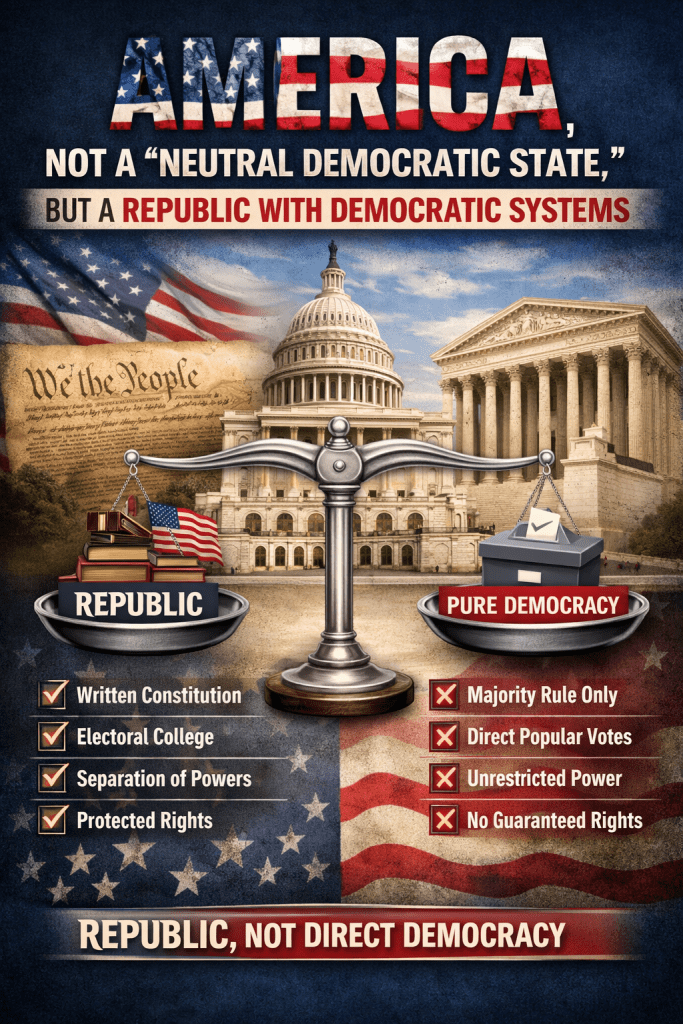
The United States is often described simply as “a democracy.” That description is incomplete.
From its founding, the United States was established as a constitutional republic—designed to limit majority rule through law, structure, and institutional constraints. This framework is laid out in the United States Constitution.
America was not created as a system of pure, direct democracy. It was designed as a republic that incorporates democratic mechanisms within a system of checks and balances and protections against majority excess.
A REPUBLIC WITH DEMOCRATIC MECHANISMS
The United States uses democratic processes: elections, representation, and political competition.
However, these operate within a constitutional framework that constrains power.
This creates a dual structure:
Foundational system: a constitutional republic
Operational tools: democratic elections and representation
Key features reinforce this structure:
Elected representatives—not direct rule by the public
The Electoral College for presidential elections
A bicameral legislature balancing population and state representation
Judicial review limiting legislative and executive power
This is not a pure democracy. It is a republic that uses democratic systems.
CONSTITUTIONAL LIMITS ON MAJORITY RULE
In a pure democracy, the majority can impose its will directly. In the United States, that power is deliberately restricted.
The Constitution establishes:
Separation of powers between branches of government
Federalism, dividing authority between national and state governments
Entrenched rights that cannot be overridden by a simple majority vote
The United States Bill of Rights explicitly protects individual freedoms from government action—even if a majority supports restrictions.
This is a defining characteristic of a republic: rights are not subject to popular vote.
NO IDEOLOGICAL NEUTRALITY IN FOUNDING PRINCIPLES
The United States is often described as “neutral,” but its founding is rooted in specific philosophical principles.
These include:
Individual rights
Limited government
Rule of law
Protection of private property
These principles are embedded in the United States Declaration of Independence and reflected throughout the constitutional system.
The state is not ideologically empty—it is built on a defined political philosophy.
AMERICA VS. PURE DEMOCRACY: A STRUCTURAL DIFFERENCE
Understanding the United States requires distinguishing it from a pure democracy.
- SOURCE OF AUTHORITY
United States: Authority is constrained by a written constitution.
Pure democracy: Authority flows directly from majority rule. - DECISION-MAKING
United States: Indirect, through elected representatives and layered institutions.
Pure democracy: Direct voting on laws and policies. - LIMITS ON POWER
United States: Constitutional rights override majority decisions.
Pure democracy: Majority decisions are typically final. - STRUCTURE
United States: Federal system with divided sovereignty.
Pure democracy: Centralized authority based on voter outcomes.
A DISTINCT MODEL — NOT PURE DEMOCRACY
The United States does not fit the definition of a pure democracy:
It is not direct rule by the majority
It is not a system without constitutional constraints
It is a constitutional republic that uses democratic processes within defined limits.
WHY THE DISTINCTION MATTERS
Calling the United States simply “a democracy” obscures how the system actually functions.
The American system was designed to:
Prevent concentration of power
Protect individual rights against majority pressure
Ensure long-term stability over short-term popular demands
Understanding this structure is essential to understanding American governance.
CONCLUSION
The United States is best understood as:
A constitutional republic
Operating through democratic elections
Structured to limit and balance power
It is not a neutral, unconstrained democracy. It is a republic with democratic systems—by design.
 Resisting Islamism & Communism