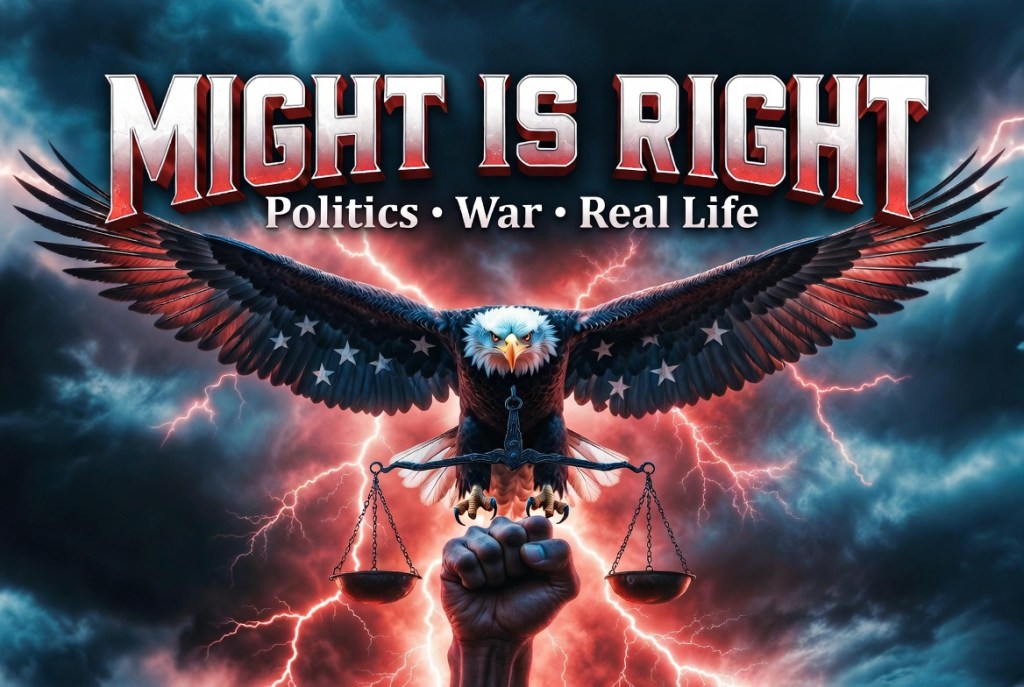
Might Is Right: The Brutal Truth in Politics, War, and Real Life
In the arena of human affairs, few principles cut through the illusions of morality, law, and “fairness” like “Might is Right.”
This ancient idea—that power, strength, and the will to wield them ultimately decide what prevails—underpins reality more than most care to admit. It echoes through history, from Thucydides’ Melian Dialogue (“the strong do what they can and the weak suffer what they must”) to modern geopolitics and everyday struggles. Deny it at your peril. Civilizations built on wishful thinking crumble when raw power confronts them.
Might in Politics: The Illusion of Consent
Politics is not a gentle debate club of ideas.
It is the organized exercise of power. “Might is Right” reveals that elections, constitutions, and parliaments often serve as velvet gloves over iron fists.
The side with superior organization, financial muscle, demographic leverage, cultural dominance, or willingness to intimidate wins.
History’s tyrants understood this instinctively.
Communist regimes exemplified it brutally: Lenin’s Bolsheviks seized Russia not by the will of the majority but by disciplined force and terror. Mao’s China consolidated power by the barrel of the gun.
Today’s softer variants persist—ideological capture of institutions, censorship disguised as “hate speech” laws, demographic engineering through mass migration, and economic coercion. In the West, elites wield regulatory power, media monopolies, and financial leverage to marginalize dissent. Islamism follows the same pattern: where it gains numbers and institutional footholds (New York City, Dearborn, Hamtramck, parts of Europe), it demands accommodations, then dominance. Adhan blasts that overwhelming neighborhoods aren’t requests; they are assertions of territorial might through noise and presence.
Individualists reject the collectivist lie that “the people,” “the ummah,” or “the proletariat” hold legitimate power. Legitimacy flows from protecting individual rights, not from mob or clerical force. Yet reality bites: a determined minority wielding might—street muscle, bureaucratic control, or voting blocs—can impose its will on a disorganized majority. The American Founders grasped this by embedding checks and balances and an armed citizenry to counterbalance raw might with structured liberty. Without vigilance, might devours rights. Civilized intolerance toward supremacist ideologies isn’t hatred—it’s the necessary assertion of Western might to preserve freedom.
Might in War: The Decider of Civilizations
War strips away pretenses.
Treaties, norms, and Geneva Conventions bind only the weak or those who fear reprisal.
Victors write history and define “justice.”
The Islamic conquests spread by the sword from Arabia across continents, subjugating cultures under Sharia.
The Ottoman Empire’s might enforced dhimmitude.
In the 20th century, Nazi Germany’s blitzkrieg and imperial Japan’s aggression showed might’s logic until greater industrial and military might crushed them.
Today’s conflicts—Ukraine, Middle East proxy wars, Islamist insurgencies—follow suit.
Hamas, Hezbollah, and their backers prioritize rockets, tunnels, and human shields over “proportionality.” They understand that survival favors the ruthless.
Even “rules-based” powers bend to might.
Nuclear deterrence works because mutual assured destruction enforces a balance of terror.
Weak nations invite predation; strong ones project power.
America’s post-WWII order succeeded through overwhelming might paired with relative restraint—not universal benevolence.
In the “Adhan Noise Wars” and cultural infiltration, the pattern repeats domestically: incremental assertions of power (loudspeakers, parallel societies, demands for blasphemy laws) test resolve. Yield, and enclaves become caliphates. Resist with superior cultural, legal, economic, and, if needed, physical might—or lose.
Might does not make moral right, but it determines who survives to argue the point.
Pacifism in the face of jihad or totalitarianism is suicide.
Might in Real Life: Daily Power Struggles
“Might is Right” applies on the personal scale, too. In business, the stronger negotiator, the better-capitalized firm, or the more persistent competitor prevails.
Socially, status, networks, physical presence, and psychological resilience determine outcomes. Bullies test boundaries; the unprepared suffer. In relationships and communities, those willing to enforce standards—through reputation, alliances, or direct confrontation—shape norms. Demographic shifts in neighborhoods demonstrate this: groups with higher birthrates, chain migration, and communal solidarity impose their culture when the host society lacks the will to assert its own.
Yet might without wisdom destroys. A thug with fists rules the street until law enforcement (greater might) intervenes. A corrupt politician dominates until exposed and replaced. Raw power, unchecked, breeds chaos; channeled through principle, it builds enduring order.
The Individualist Response: Structured Might
“Might is Right” is descriptive, not prescriptive. It reveals human nature stripped of delusion. Collectivists—Islamists and Communists—embrace it openly in pursuit of domination. Individualists must wield it defensively to preserve themselves and promote human flourishing.
The antidote isn’t pretending at equality of outcome or universal goodwill. It is cultivating personal strength (mind, body, resources), defending the rule of law that protects the sovereign individual, and asserting cultural might through truth-telling, economic boycotts, legal pushback, and demographic realism. The “Infidel Manifesto” spirit—civilized intolerance toward political Islam and collectivism—embodies this: recognize the threat, reject naive coexistence, and mobilize superior ideas backed by resolve.
Live and let live, but do not surrender to those who proclaim “convert, submit, or die.” Arm yourself with knowledge of history, the Quran, the Sira, and the Hadith. Build parallel structures that resist infiltration. Support leaders and policies that prioritize national sovereignty and individual rights over globalist or theocratic power.
In the end, might decides. The question is whether free individuals and their civilizations will summon the strength to prevail—or whimper into subjugation. History favors the bold who understand power. The rest become footnotes.
The time for illusions is over. Assert what is right—by force, if necessary.
Discover more from Resisting Islamism & Communism
Subscribe to get the latest posts sent to your email.

