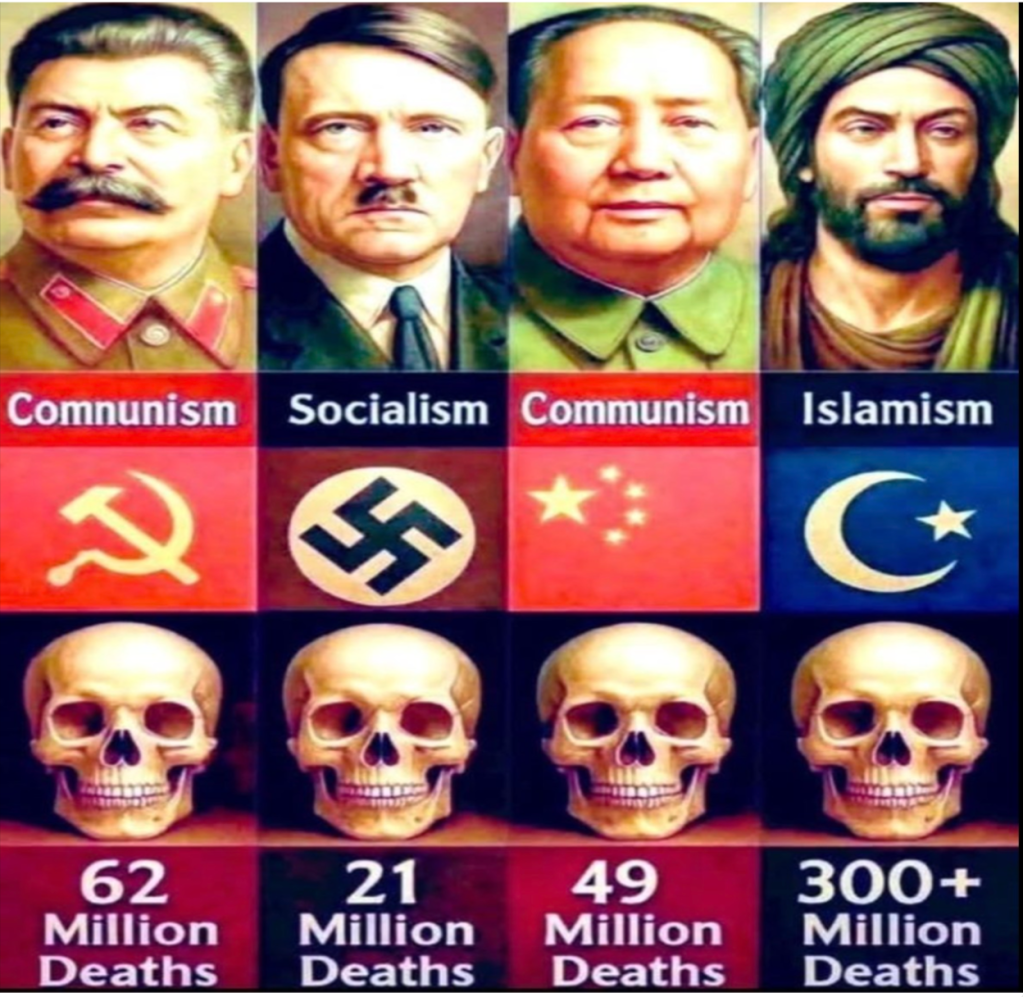
Public debate often treats Islamism and Communism as ideological opposites. One is religious, the other secular. One appeals to God, the other to history. Because of this contrast, comparisons between them are frequently dismissed as crude or offensive. That dismissal is a mistake.
When examined not as belief systems but as political projects, Islamism and Communism reveal striking similarities in how they understand power, society, and the individual. These similarities matter not because the ideologies are identical, but because they generate comparable political dangers.
Both Islamism and Communism function as total ideologies. They do not merely propose policies or reforms; they claim authority over the whole of life. Law, education, culture, morality, and identity are expected to conform to a single ideological framework. There is no neutral space, and no legitimate alternative worldview. Politics becomes an extension of ideology rather than a forum for citizen negotiation.
In such systems, dissent is not treated as disagreement but as corruption. The dissenter is reclassified as an apostate, a counter-revolutionary, or an enemy of justice. Authority is justified not through consent or accountability, but through claims to higher truth—divine revelation in the case of Islamism, historical inevitability in the case of Communism.
This logic explains a second shared feature: deep mistrust of the individual.
Communist theory subordinates the individual to class identity and the historical mission of socialism. Islamist political thought subordinates the individual to divine law as interpreted by religious-political authority. In both cases, freedom is tolerated only insofar as it reinforces ideological goals. Independent thought becomes instability. Personal choice becomes disorder.
Pluralism, therefore, poses an existential threat. Competing values fracture ideological certainty, and certainty is the foundation of authority. Once unity is treated as morally sacred, coercion becomes justified. Surveillance, censorship, and punishment follow not as deviations but as necessities.
The emotional engine of both ideologies is justice.
Communism frames justice primarily in economic terms, opposing exploitation and inequality. Islamism frames justice in moral and social terms, opposing corruption and oppression. These grievances are often real, which is precisely why the ideologies gain traction. But both make the same fatal move: they claim exclusive ownership of justice itself.
Once justice becomes ideological property, opposition automatically becomes injustice. Repression is rebranded as enforcement. Violence becomes purification. Power no longer requires restraint because it presents itself as morally necessary.
The differences between Islamism and Communism should not be ignored. Communism is explicitly secular and often hostile to religion. Islamism derives legitimacy from divine command. One speaks in the name of history, the other in the name of God.
But this difference does not neutralize the political risk. When leaders claim to speak for God, who can challenge them? When leaders claim to speak for history, who can resist the inevitable?
The lesson is not that faith is dangerous or that concern for equality is misguided. It is that any ideology—religious or secular—becomes dangerous when it demands total authority over human life.
Free societies survive not because they are perfect, but because they are limited. Limited government. Limited certainty. Limited power. They accept disagreement as permanent and pluralism as unavoidable.
The real political divide is not between left and right, or religious and secular. It is between systems that accept limits and those that do not.
History is unambiguous on this point: ideologies that promise heaven on earth too often demand obedience first, and humanity later.
Discover more from Resisting Islamism & Communism
Subscribe to get the latest posts sent to your email.
 Resisting Islamism & Communism