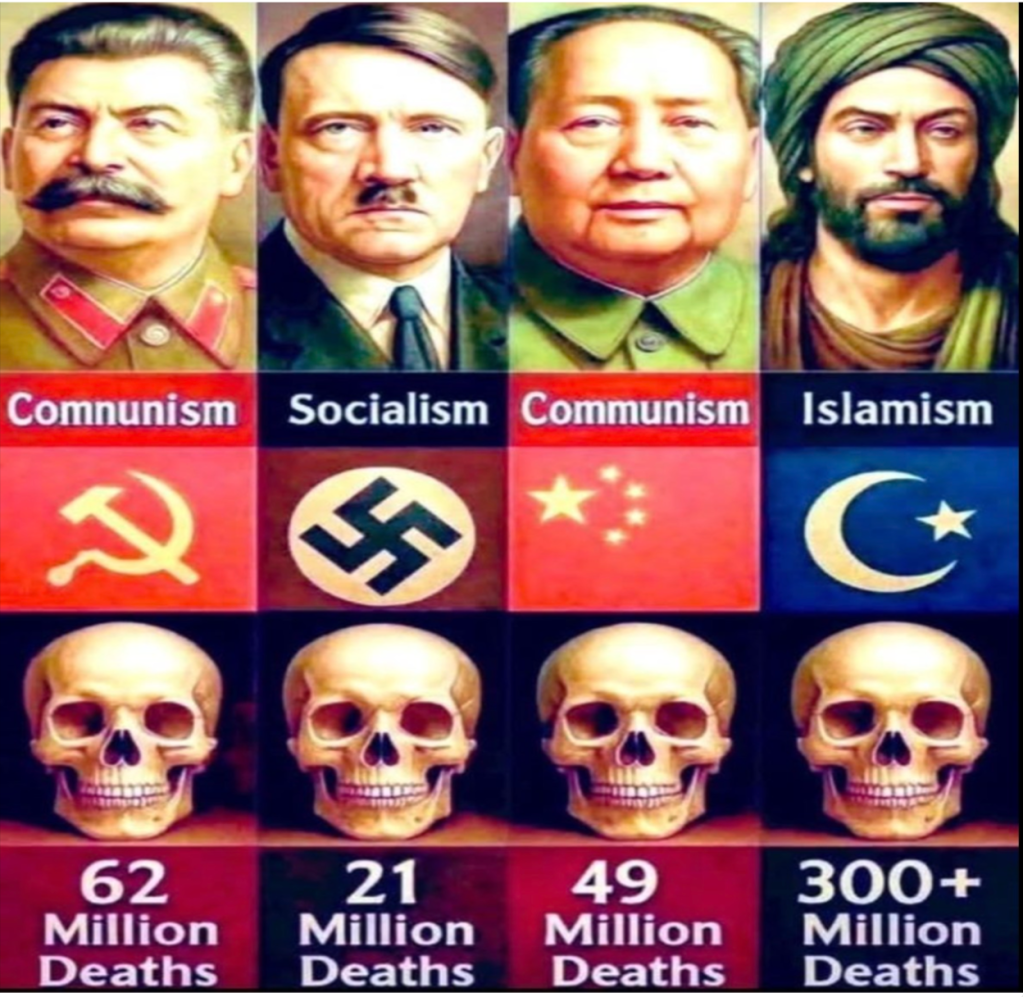
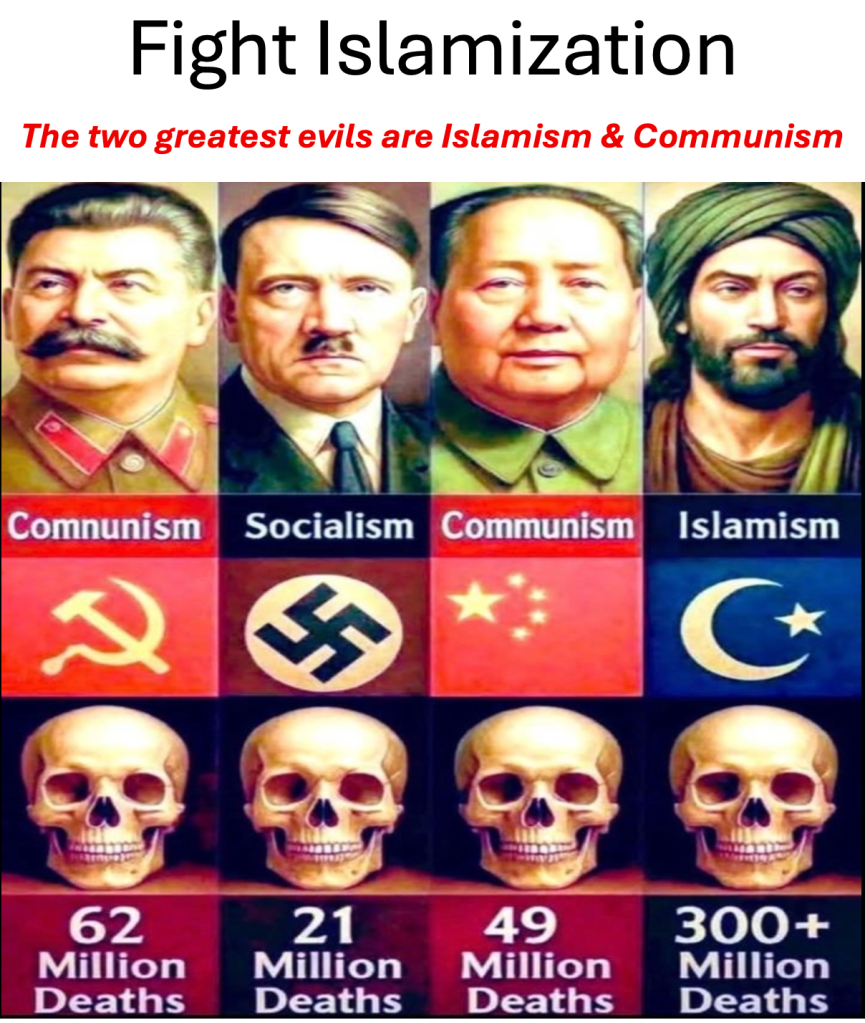
Public debate often treats Islamism and Communism as ideological opposites. One is religious, the other secular. One appeals to God, the other to history. Because of this contrast, comparisons between them are frequently dismissed as crude or offensive. That dismissal is a mistake.
When examined not as belief systems but as political projects, Islamism and Communism reveal striking similarities in how they understand power, society, and the individual. These similarities matter not because the ideologies are identical, but because they generate comparable political dangers.
Both Islamism and Communism function as total ideologies. They do not merely propose policies or reforms; they claim authority over the whole of life. Law, education, culture, morality, and identity are expected to conform to a single ideological framework. There is no neutral space, and no legitimate alternative worldview. Politics becomes an extension of ideology rather than a forum for citizen negotiation.
In such systems, dissent is not treated as disagreement but as corruption. The dissenter is reclassified as an apostate, a counter-revolutionary, or an enemy of justice. Authority is justified not through consent or accountability, but through claims to higher truth—divine revelation in the case of Islamism, historical inevitability in the case of Communism.
This logic explains a second shared feature: deep mistrust of the individual.
Communist theory subordinates the individual to class identity and the historical mission of socialism. Islamist political thought subordinates the individual to divine law as interpreted by religious-political authority. In both cases, freedom is tolerated only insofar as it reinforces ideological goals. Independent thought becomes instability. Personal choice becomes disorder.
Pluralism, therefore, poses an existential threat. Competing values fracture ideological certainty, and certainty is the foundation of authority. Once unity is treated as morally sacred, coercion becomes justified. Surveillance, censorship, and punishment follow not as deviations but as necessities.
The emotional engine of both ideologies is justice.
Communism frames justice primarily in economic terms, opposing exploitation and inequality. Islamism frames justice in moral and social terms, opposing corruption and oppression. These grievances are often real, which is precisely why the ideologies gain traction. But both make the same fatal move: they claim exclusive ownership of justice itself.
Once justice becomes ideological property, opposition automatically becomes injustice. Repression is rebranded as enforcement. Violence becomes purification. Power no longer requires restraint because it presents itself as morally necessary.
The differences between Islamism and Communism should not be ignored. Communism is explicitly secular and often hostile to religion. Islamism derives legitimacy from divine command. One speaks in the name of history, the other in the name of God.
But this difference does not neutralize the political risk. When leaders claim to speak for God, who can challenge them? When leaders claim to speak for history, who can resist the inevitable?
The lesson is not that faith is dangerous or that concern for equality is misguided. It is that any ideology—religious or secular—becomes dangerous when it demands total authority over human life.
Free societies survive not because they are perfect, but because they are limited. Limited government. Limited certainty. Limited power. They accept disagreement as permanent and pluralism as unavoidable.
The real political divide is not between left and right, or religious and secular. It is between systems that accept limits and those that do not.
History is unambiguous on this point: ideologies that promise heaven on earth too often demand obedience first, and humanity later.
Socio-Feudalism’s War on the Individual By Daniel Greenfield
The transformation of the medieval world into the modern world came about with the idea that man could and should transform his lot in life.
The liberal individualism of the Enlightenment however was soon countered by reactionary movements, feudal and socio-feudal, seeking to put the genie of individual autonomy back in the box through collectivist movements.
Socialism postured as progressive when it was reactionary. Its leaders, most often hailing from the upper class and upper middle class, reverted newly liberated societies in Russia and China back to feudalism under the guise of liberating them. The Bolsheviks took Czarist feudalism and rebranded it as collective farming, forbidding the “liberated” farmers from owning property or livestock, and even from leaving their farms to seek a better life in the big cities.
The empowerment of the individual had given way to the enslavement of man in the service of an ideal society. Individuals were once again worthless, except as they fit into a larger plan.
The ultimate struggle will be less about movements and more about individuals. The more the system fails, the more repressive it will become. And only millions of individuals can defeat it.
Socio-feudalism has the destruction of individual autonomy as its central goal.
The transformation of the medieval world into the modern world came about with the idea that man could and should transform his lot in life.
The liberal individualism of the Enlightenment however was soon countered by reactionary movements, feudal and socio-feudal, seeking to put the genie of individual autonomy back in the box through collectivist movements.
Among the most prominent of these was what would eventually be called socialism.
While early socialist movements had been a radical Christian heresy emphasizing communal living, these experiments invariably failed on a local level, leaving behind a trail of wrecked lives.
Nineteenth-century radical theorists began laying out plans for the communal transformations of entire societies.
Fourier’s socialist “phalanxes” which would influence everything from Soviet communal farms to hippie communes in the United States, were feudal mass communities with no private property and everyone assigned a role in life under the rule of a centralized “omniarch”.
Socialists had to justify the elevation of the collective over the individual through fatalism about the role of man.
All evidence to the contrary, man has no ability to change his lot in life. He is only an atom in the larger phalanxes of life. As Robert Owen, the father of British Socialism, told the US Congress in an address in 1825, man “never did, nor is it possible he ever can, form his own character,” but is “universally plastic” and socialists could make him over into anything at all.
The US Declaration of Independence asserted that man was born free, but to the socialists he was born a slave and the best that he could ever hope for was to be a slave to the right cause.
Ralph Waldo Emerson insightfully critiqued Fourier: “He treats man as a plastic thing, something that may be put up or down, ripened or retarded, moulded, polished, made into solid, or fluid, or gas, at the will of the leader… but skips the faculty of life, which spawns and scorns system and system-makers, which eludes all conditions, which makes or supplants a thousand phalanxes and New-Harmonies with each pulsation.
Was man a “plastic thing” or the bearer of the mystery of the “faculty of life”?
Leftist revolutionary movements might begin by hailing the power of the individual, but invariably ended up in a socio-feudalism system making malleable man over to fit the five-year plan.
Socialism postured as progressive when it was reactionary. Its leaders, most often hailing from the upper class and upper middle class, reverted newly liberated societies in Russia and China back to feudalism under the guise of liberating them.
The Bolsheviks took Czarist feudalism and rebranded it as collective farming, forbidding the “liberated” farmers from owning property or livestock, and even from leaving their farms to seek a better life in the big cities.
The empowerment of the individual had given way to the enslavement of man in the service of an ideal society. Individuals were once again worthless, except as they fit into a larger plan.
The socialist argument against individualism was human fallibility. The muckrakers gathered every example of misery and described them as social ills that society had to collectively remedy. Outwardly private philanthropic organizations claimed to help the poor, but their embrace of eugenics, including mandatory sterilization, seizing children from parents, prohibition, and greater state intervention, including mandatory centralized state education, set a pattern that was innately socialist even when its proponents avoided the use of the word.
Every crisis, including World War I and the Great Depression, was seen as a reason for replacing smaller institutions with larger ones and further disempowering the individual.
Hitler’s National Socialist party blamed Germany’s loss in WWI partly on free enterprise. Roosevelt and the Democrats blamed the Great Depression on free enterprise. Both built state systems for seizing control of it.
The Russian Bolsheviks not only blamed individual farmers for their famine, but used it to wipe them out.
The post-war economic rebound in America and Europe did not end socialism, but rebooted it, with governments confiscating even more wealth for “the benefit of society.”
The macro conflicts of WWII and the Cold War, the threat of nuclear annihilation, were used to define the individual as too small to make a difference on his or her own except as part of a larger mass movement.
In the 1960s, class warfare gave way to identity politics. Individuals had to join groups to fight for a fairer society. What governmental institutions had failed to accomplish in fully transforming man, the new movements set out to accomplish in the psychedelic decade. The individual was told that liberation would come from losing his bourgeois background, worldview, inhibitions, morality and values to a new emerging humanistic blob shooting along the rainbow to the right side of history.
The 1980s marked a reassertion of individual priorities over mass movements. The movements that had broken the country were distrusted. Socio-feudalism struck back with an environmental crisis taking place on such a scale that individuals were nothing when measured against it.
Global authorities had to immediately seize total power to save the human race.
Environmentalism has brought socio-feudalists closest to realizing Fourier’s vision of abolishing private property and packing everyone off to collective compounds with a defined role in life: Man has had his day, but individuals can’t help selfishly wrecking the planet. Only subservience to larger systems can stop global warming, end human misery and transform the world.
A new wave of gender identity activism further eliminated the line between the individual and the state. The personal was political at the most granular level. The pronouns you used, the products you bought, whether you left the light on or not, were political choices. Human existence became a series of political tests measuring allegiance to a state ideology.
When the personal is political, there is nothing personal left to the individual.
Socio-feudalism had contrived to reduce man to a state of total subservience.
Medieval England banned playing games, especially “fute-ball” because it was seen as a distraction from the priorities of the state.
Postmodern California passed two laws outlawing Indian mascots, along with plastic bags, gendered toys and a thousand other things.
Postmodern man occupies a world of illusory technologies and shrinking possibilities where children are discouraged from riding bikes, packed off to early schooling at toddlerhood and indoctrinated to believe that their playthings are the reason for the destruction of the world.
Socio-feudalism has the destruction of individual autonomy as its central goal, and the pandemic lockdowns showed how easy that goal is to achieve in the face of a crisis. Government could and did assert control over what an individual could wear and whether he could leave the house. The public eventually responded to it not with a mass movement, as those mostly failed or were repressed, but by unilaterally discarding the prohibitions of the state.
Americans had ultimately fulfilled Emerson’s faith in “the faculty of life, which spawns and scorns system and system-makers, which eludes all conditions.” And that is why socio-feudalism will fail unless it can reduce mankind to a state of abject helplessness, ignorance and fear.
That is what Communist and Islamist regimes strove for,with varying degrees of success. And it is still the great aim of socio-feudalism today.
The ultimate struggle will be less about movements and more about individuals.
The more the system fails, the more repressive it will become. And only millions of individuals can defeat it.
If a person burns the Bible, no Christian or Jewish law calls for the death penalty. If a person burns the Quran, Islam’s laws punish this stupidity with Death.
The Democratic Party has become a modern incarnation of the Communist Party. Its agenda represents an ongoing assault on the U.S. Constitution and on the principles of individualism.





 Resisting Islamism & Communism